In 2010 and 2011, the Maryland State Highway Administration (SHA), the US Navy, and Maryland Historical Trust (MHT) conducted archaeology surveys in the Patuxent River on a War of 1812 shipwreck. This blog documents our underwater archaeology surveys.


July 18, 2011

Bow or Stern?

Today, we excavated a large amount of sediment from both ends of the wreck.  Within the next day we should expose enough of the exterior of the hull to feel the shape and understand a bit more about the architecture.  The downstream end is full of heavy timbers and may represent the bow....but, we just don't quite have enough exposed to know at this point.  Tomorrow we should know the length of the shipwreck....any guesses?
Another busy day on the barge. Part of the duties of an underwater archaeologist is to keep the pumps running.
During all of the dredging away of the sediment, we often find pieces of garbage in the overburden.  Today we brought up and tossed out a clay pigeon, long glass tube florescent light, coffee can, bottles, and a golf ball. At the end of the day, we found a large jaw bone that may have belonged to a horse. We joked about how Barney had cavalry in his flotilla.  In reality, this bone was found outside, but adjacent to, the upstream part of the wreck--so it may have washed in at anytime during the last 200 years. A faunal analyst will be making the final identification for us.
UPDATE: Dr. Guy Tasa identified the bone as a cow madible, left side. Thanks Guy!
Mandible from a cow (left side).


July 15, 2011

The Smoking Barrel Stave?

Although we did not remove much overburden across the wreck today, we did map in some important points, including the northern end of the wreck site. In addition, we maneuvered the heavy 12 ft. long shoring into place that should cover part of the hold. Since the shoring is so heavy, we used plastic lift bags filled with air to help position the box over the exact spot.
Troy Nowak, Assistant State Archaeologist, discusses placement of shoring with US Navy underwater archaeologists Brad and George.

While exploring the northern part of the wreck we came upon a curious piece of wood.  It was a barrel stave! It measures 22 in. tall, by 4 in. at the center, and is about an inch thick in the center. Was this part of a powder keg that sunk this vessel? Powder kegs did come in this size of barrel during the War of 1812. Of course, the stave may just be the remains of a food or beverage cask.
 Interior of the stave--note the groves on the ends.
Close up view of wooden cask stave. The exterior and interior are colored black. 

July 14, 2011

North End of Wreck Found


After the first week of excavation, we have found the northerly end of the shipwreck.  There seems to be some damage to it, but we are unsure if the damage is from age or from the actual scuttling of the vessel 200 years ago.
Dr. Susan Langley gets help with her equipment from assistant state archaeologist Troy Nowak. 

At the end of the day, diver Dan came up to explain what he felt while dredging away the sediment and exposing the wreckage. The visibility is terrible, and it takes effort to even see your hand in front of your face--visibility is only about a foot.


Now that we have one end of the wreck defined, our goals will be to find the other end and excavate in the center to locate the hold.  Tomorrow our SHA surveyors will be out on the site shooting in one end of the wreck as well as other points marked in the river by our archaeologists. 


July 12, 2011

Amazing Progress

Today it was 95 degrees under our shade canopies--jumping in the water to swim in pea soup water was a welcome relief. Both teams have found the wood of the wreck in their trenches.  The water visibility was very poor due to last night's unexpected thunderstorm, but we still were able to dredge down and feel the shape of the wreck.  Since you can't see the wood, there is a different type of excitement when you feel the ship....your hands take in the shape and smoothness of the architecture. It is a magical experience to think that 200 years ago Joshua Barney ordered his men to scuttle his flotilla, and here it is nestled beneath twigs and sand just waiting to reveal its secrets. Tomorrow we continue on dredging trying to learn more about the size and shape of the site.
Lee Cox and Julie Schablitsky hold on to the ladder to keep from being swept up stream.
Diver probes out wreck to verify their location.

July 11, 2011

Already on the Wreck


Today, there were two teams of archaeologists working on the the bow and stern of the wreck--we are not sure which end is which, but we should find this out by the end of the week. Based on the hydroprobing results, the wreck appears to be at a bit of an angle in the river and is orientated in a northwest to southeast direction.

View of map showing hydroprobe results with the black line delineating the baseline.

The north, or upstream, end of the wreck was reached this afternoon.  A 10 ft. x 6 ft. trench was dredged down on the north end of the wreck to try and delineate the edges and end. We stopped at the clay silt stratum that encases the wreck. During the dredging, a piece of worked pine wood was encountered and immediately placed back in water on the barge for conservation.
Worked, pine wood piece found just on top of the wreck this afternoon. 

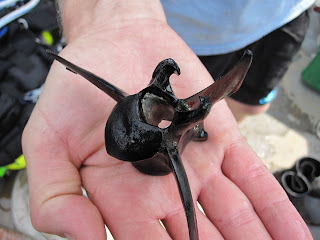
While the northern end of the wreck was being delineated, the second team of archaeologists worked to expose the southern end of the wreck. During the dredging of the sandy overburden, an animal bone popped up that looks like a vertebrae from a deer or other medium sized mammal.  Since it was not in direct association with the wreck, it may just be a random bone deposited in the more recent past. 

A medium sized mammal vertebrae recovered from the sandy stratum above the wreck.


Tomorrow, we will be back on the wreck and may even begin screening the thin, silty-clay stratum over the wreck. Make sure to visit MPT's blog on the making of Search for the Scorpion.

The bubbles on the left and then on the right show divers dredging the ends of the wreck.


July 8, 2011

All Hands on Deck

Today the metal shoring to hold back the sediment in our excavation units arrived at the Patuxent River Park.  MNCPPC loaded the shoring onto a flat bed truck and transferred it up river to the Patuxent River Trailer Park and down to the boat ramp where several US Navy divers assembled, attached the shoring to the side of their boat, and moved it to the shallow waters of the river within reach of the site.

Watch a short clip of Navy Divers and others unloading shoring, working on the barge, and filming of the action.

While the Navy was busy moving shoring, the rest of the crew set up and organized the barge, readying it for diving.  Maryland Public Television (MPT) was there to capture the action.  MPT also documented conversations between Susan, Bob, and Julie discussing how to first excavate the wreck. The excavation will begin on the ends of the wreck as well as the center.  Last year we came away with only a curious lead weight---but this year we will encounter artifacts in the hold of the vessel. In addition to the artifacts, we also expect to understand the condition (e.g. did the sides collapse outward) and orientation of the wreck.
 US Navy divers attaching shoring to boat.
 Shoring ready to be assembled.
Dr. Susan Langley talking to Mike English and Tim Pugh.

In addition to organizing shoring and filming, we also tested the pumps to ensure we can start dredging away the sediment first thing tomorrow morning.

July 7, 2011

Phase II of the 2011 Archaeology Project Starts Tomorrow

 After a two week break, we will be back excavating on the wreck tomorrow. It took a few days to mobilize the barge and equipment and float it up the river from Selby's Landing at the Patuxent River Park.  But, we now have a 38 ft. x 18 ft. aluminum barge anchored near the site along with a bright yellow sediment curtain.  Once excavation starts, the overburden will be pumped into the sediment curtain to keep it from going down river. Tomorrow we will be assembling the metal shoring and removing some overburden that now sits atop the wreck.  Maryland Public Television will also be arriving in the late afternoon to capture footage for a 30 minute documentary on the USS Scorpion archaeology project. Be sure to check back for our daily updates through the first week of August.


View towards southwest of aluminum barge. The yellow tanks hold water to rinse dive equipment. The wreck is located on the opposite side of the barge.